How to Install Plugin Mirage in Cacti

Prerequisites:

Cacti version 0.8.8+ It may work on previous versions, but we haven’t tested against them.
PIA version 3.1

Download Mirage Plugin 1.2.0

Dowload Mega URL: https://mega.nz/#F!joBCSajS
Key: !5xOf-FjcDAkkS3K2TkAkTA

Installation:

Move the folder mirage to CACTI_HOME/plugins/
Ensure permission are correct (CACTI_HOME/plugins/mirage)

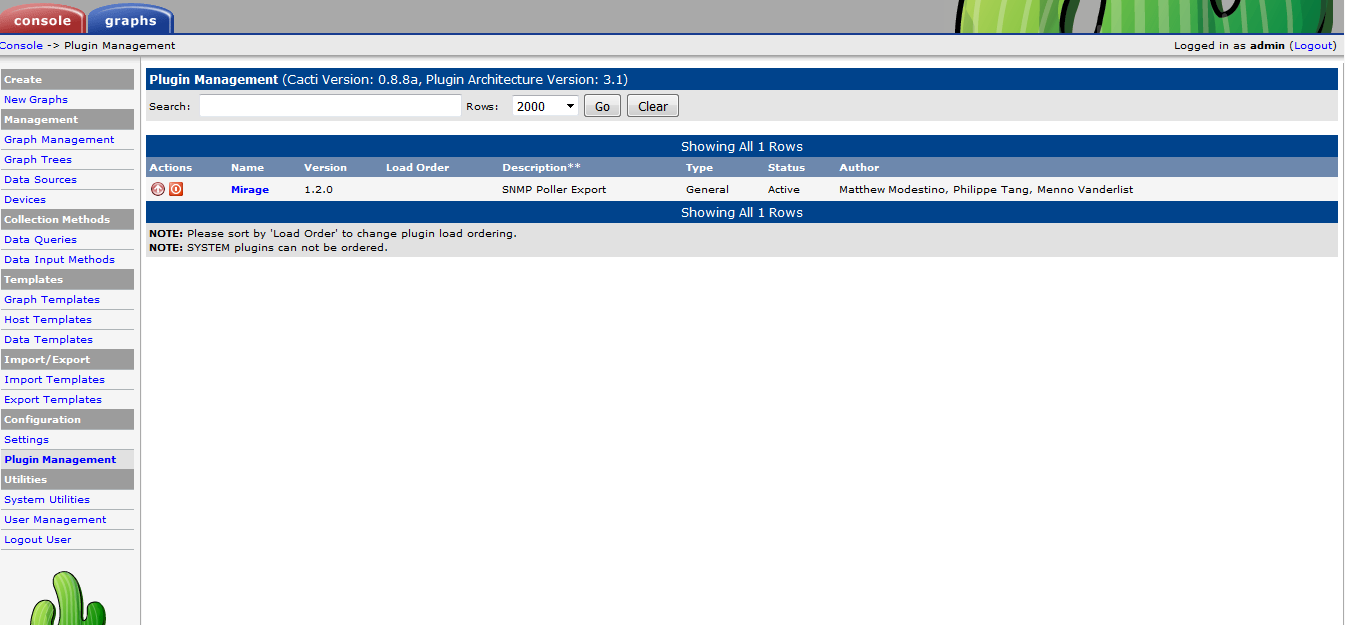
Install Mirage through Cacti Plugin Management /Enable Mirage pluging through Cacti Plugin Management

cacti

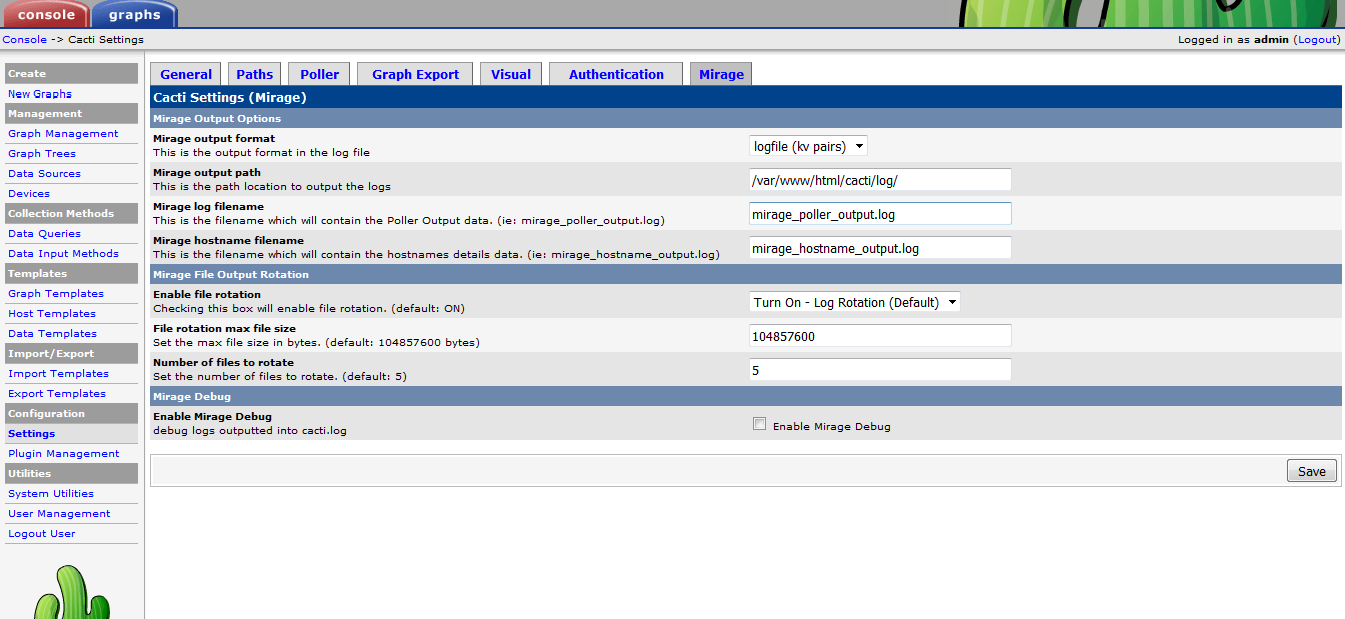
Review and save Mirage settings

managemente-cacti

After installation it should generate a file called ” mirage_poller_output.log ” within the / var / www / html / cacti / log /

That is all!

Continue Reading

Easy Samba installation on RHEL/CentOS 7

Samba is a client/server system that implements network resource sharing for Linux and other UNIX computers. With Samba, UNIX files and printers can be shared with Windows clients and vice versa. Samba supports the Session Message Block (SMB) protocol. Nearly all Windows computers include SMB support with their internal network subsystems (NetBIOS in particular).
With an appropriately-configured Samba server on Linux, Windows clients can map drives to the Linux filesystems. Likewise, theSamba client on UNIX can connect to Windows shares by their UNC name. Although differences among various operating systems (such as filesystem naming conventions, end-of-line conventions, and authentication) can limit interoperability, Samba offers a generally serviceable mechanism for resource sharing on a heterogenous network.
In this tutorial we will show you how to install and configure Samba server on RHEL and CentOS 7 linux.

Install and configure Samba on Rhel/CentOS 7
To install samba packages enter following command:

#yum install samba samba-client samba-common -y

Now configure samba edit the file /etc/samba/smb.conf

#mv /etc/samba/smb.conf /etc/samba/smb.conf.bkp
#vi /etc/samba/smb.conf

and paste following line:

[global]
workgroup = WORKGROUP
server string = Samba Server %v
netbios name = centos
security = user
map to guest = bad user
dns proxy = no
#============================ Share Definitions ==============================
[Anonymous]
path = /samba/anonymous
browsable =yes
writable = yes
guest ok = yes
read only = no

Save the smb.conf file and restart the service:

#mkdir -p /samba/anonymous
#systemctl enable smb.service
#systemctl enable nmb.service
#systemctl restart smb.service
#systemctl restart nmb.service

Add these Iptables rules, so that samba will work perfectly:

#firewall-cmd --permanent --zone=public --add-service=samba
#firewall-cmd --reload

Change permission for samba share:

#chmod -R 0755 anonymous/
#chown -R nobody:nobody anonymous/

Further we need to allow the selinux for the samba configuration as follows:

#chcon -t samba_share_t anonymous/

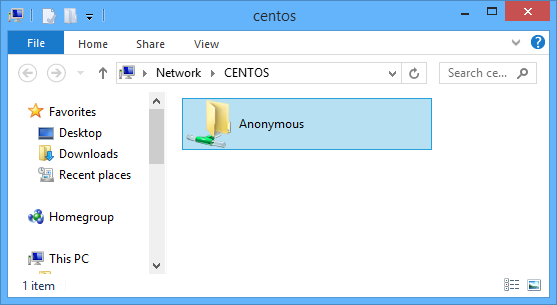
Now you can access the Centos 7.0 sharing in windows as follows, go to the Run prompt and type \centos :

image1

Acesse \\centos

image2

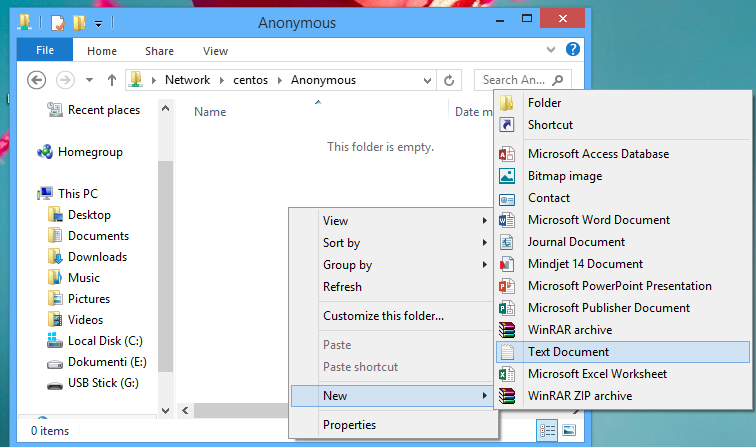
Now anonymous user can browse & create new text documents:

image3

Secured samba server

For this I will create a group smbgrp & user rasho to access the samba server with proper authentication

#useradd rasho
#groupadd smbgrp
#usermod -a -G smbgrp rasho
#smbpasswd -a rasho
[root@localhost]# smbpasswd -a rasho
New SMB password: YOUR SAMBA PASS
Retype new SMB password: REPEAT YOUR SAMBA PASS
Added user rasho.

Create a new share, set the permission on the share:

#mkdir /home/secure
#chown -R rasho:smbgrp /home/secure/
#chmod -R 0770 /home/secure/
#chcon -t samba_share_t /home/secure/

Again edit the configuration file as :

#vi /etc/samba/smb.conf

Add the newly created samba share in smb.conf file:

[Secure]
path = /home/secure
valid users = @smbgrp
guest ok = no
writable = yes
browsable = yes

Screenshot-from-2014-09-23-224711

Restart the samba service:

#systemctl restart smb.service
#systemctl restart nmb.service

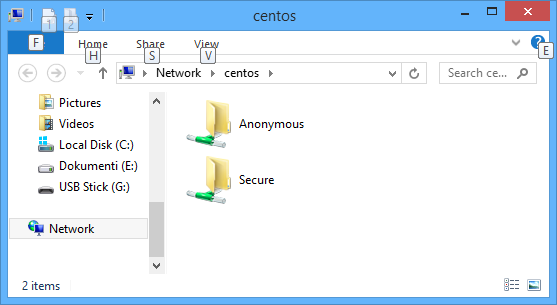
Now at windows machine check the folder now with the proper credentials

image5

Open samba sharing

image6

Create new text documents:image7

That is all!


Continue Reading

How to configure Btrfs on Centos 7

Check unit to add

#fdisk -l

Return:

Exemplo:
Selecione o disco
Disk /dev/sdb: 17.2 GB, 17179869184 bytes, 33554432 sectors
Units = sectors of 1 * 512 = 512 bytes
Sector size (logical/physical): 512 bytes / 512 bytes
I/O size (minimum/optimal): 512 bytes / 512 bytes

Adding partition:

#fdisk /dev/sdb
# M – “Show all options available”
# P – “Type ” p” to display information on the disc as the current partitions”
# n – “Show all options available”
# p – “primary partition”
# 1 – “Partition number 1”
# enter – “default”
# enter – “default”
# w “List unit”

Check unit created

# fdisk -l

Check BTRFS Version and Installation

#yum search btrfs
#yum install btrfs-progs.x86_64

FSTAB access the file and add the mount point and compression

#vim /etc/fstab

Add the following line:

/dev/sdb1 /opt btrfs compress=zlib,compress-force=zlib 1 1

Assembling Compression :

#mkfs.btrfs /dev/sdb1 -f

Restart the machine and starting from this moment the unit / opt ‘ll be using btrfs to compress the files.

Continue Reading

How to set a static MAC address on VMware ESXi virtual machine

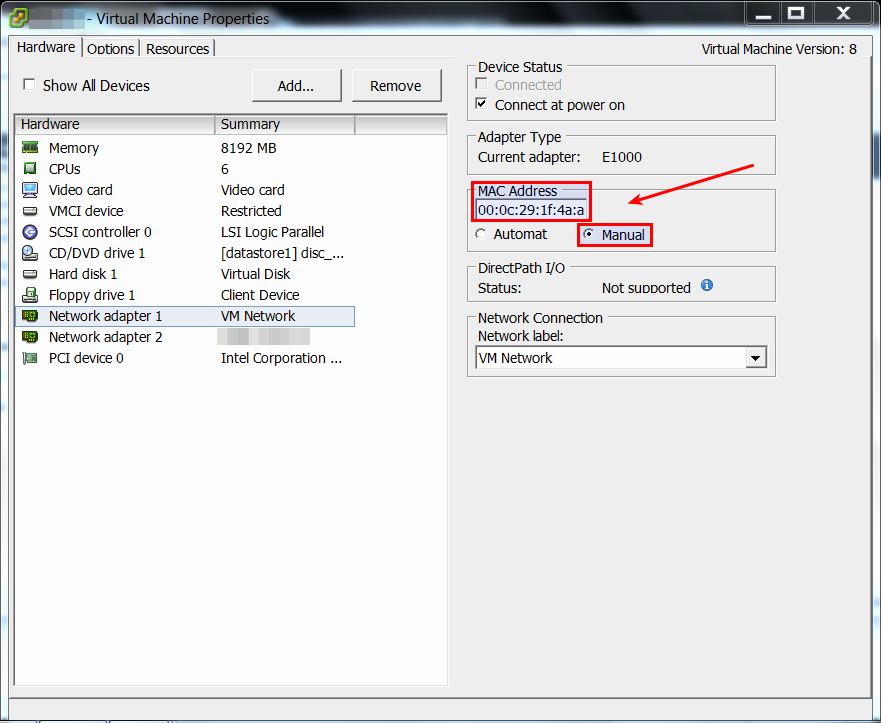
Question: I want to assign a static MAC address to a virtual machine (VM) on VMware ESXi. However, when I attempt to start a VM with a static MAC address, the VM fails to start and throws an error “The MAC Address entered is not in the valid range. Valid values are between “xx:xx:xx:xx:xx:xx” and “xx:xx:xx:xx:xx”.

When you create a VM on VMware ESXi, each network interface of the VM is assigned a dynamically generated MAC address. If you want to change this default behavior and assign a static MAC address to your VM, here is how to do it.

14726591627_338dc582dd_o

As you can see above, VMware’s vSphere GUI client already has a menu for setting a static MAC address for a VM. However, this GUI-based method only allows you to choose a static MAC address from 00:50:56:xx:xx:xx, which is VMware-reserved MAC address range. If you attempt to set any arbitrary MAC address outside this MAC range, you will fail to launch the VM, and get the following error.

3463018452_f3526cffda

Fortunately, there is a workaround to this limitation. The solution is, instead of using vSphere GUI client, editing .vmx file of your VM directly, after logging in to the ESXi host.

First, turn off the VM to which you want to assign a static MAC address.

Enable SSH access to your ESXi host if you haven’t done it already. Then log in to the ESXi host via SSH.

Move to the directory where your VM’s .vmx file is located:

# cd vmfs/volumes/datastore1/[name-of-vm]

Open .vmx file with a text editor, and add the following fields. Replace the MAC address field with your own.

#ethernet0.addressType = "static"
#ethernet0.checkMACAddress = "false"
#ethernet0.address = "00:0c:29:1f:4b:ac"

Now you should be able to launch a VM with the static MAC address you defined in .vmx file.

Continue Reading

Install Cpanel/WHM on CentOS 7, RHEL 7

Here in this article we will discuss about latest cPanel & WHM Version 11.50 feature and prerequisites and installation on fresh CentOS 7  / RHEL 7 Version.
Latest Features of cPanel  & WHM 11.50 :

CentOS , CloudLinux , and RHEL 7 support
Use the XFS  or ext4 filesystems.
Less booting time
Greylisting feature : which protect server from unwanted emails and untrusted email servers .

Installation Recommended settings:

Disable OS Firewall before installation .
Recommended Hardware :
Minimum & Recommended Processor should be 226MHZ
Minimum RAM should be 1 GB.
Minimum Disk Space should be 20 GB .

Installation of cPanel in CentOS 7 / RHEL 7 / CloudLinux 7 :

Before doing cpanel & WHM installation first ensure your OS Version , RAM and diskspace.

Deactivate firewall on CentOS 7 , CloudLinux 7 and RHEL 7 :

# iptables-save > ~/iptables.rules
# systemctl stop firewalld.service
# systemctl disable firewalld.service

Disable Security Enhanced Features ( SELinux ) :

If your server running SELinux Features of security, then disable this features .

To disable , run the below command.

Edit the configuration file /etc/selinux/config and set the parameter SELINUX to disabled, below is my configuration file , after set the parameter you need to reboot the server.

# vim /etc/selinux/config

# This file controls the state of SELinux on the system.

# SELINUX= can take one of these three values:

#     enforcing - SELinux security policy is enforced.

#     permissive - SELinux prints warnings instead of enforcing.

#     disabled - No SELinux policy is loaded.

SELINUX=permissive

# SELINUXTYPE= can take one of these two values:

#     targeted - Targeted processes are protected,

#     minimum - Modification of targeted policy. Only selected processes are protected.

#     mls - Multi Level Security protection.

SELINUXTYPE=targeted

Installation set up steps :

cPanel installation need perl package , so we need to install perl before instaalation .

# yum install perl

After installation of perl, set the hostname of server , the hostname should be in FQDN i.e fully qualified domain name. Below is steps to set hostname in Centos / RHEL 7.

Below command to check  hostname of server :

# hostnamectl

To set hostname :

#hostnamectl set-hostname cpanel.techtransit.org

Install cPanel/WHM

Now we will download cpanel script on home directory of server ,  which will install cpanel & WHM  .Follow below steps for installation.

# cd /home
# curl -o latest -L https://securedownloads.cpanel.net/latest
# sh latest

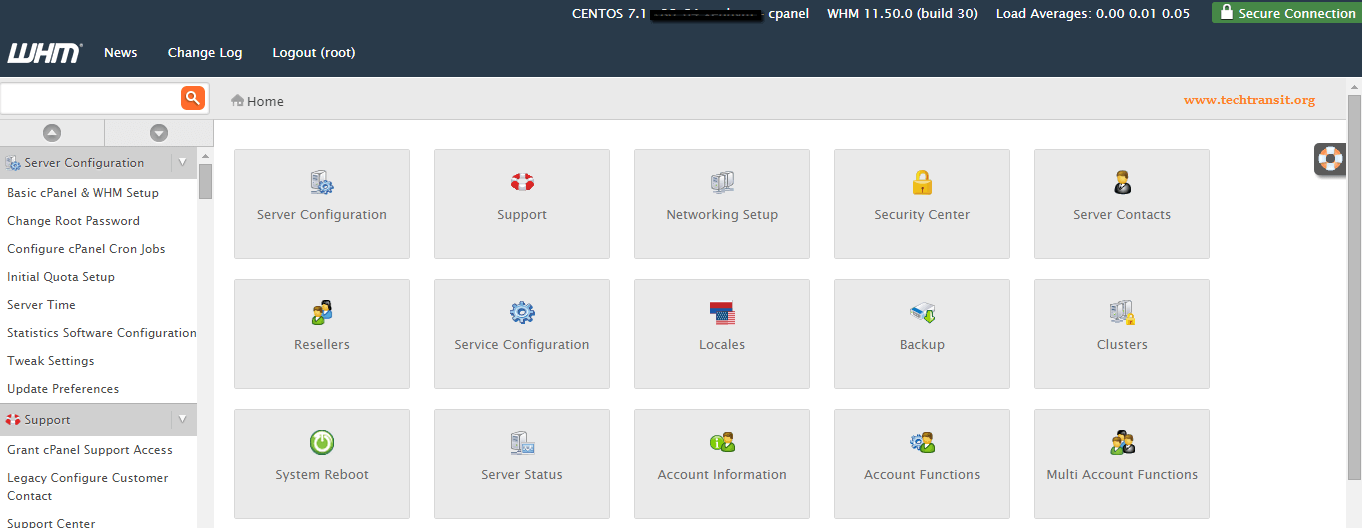
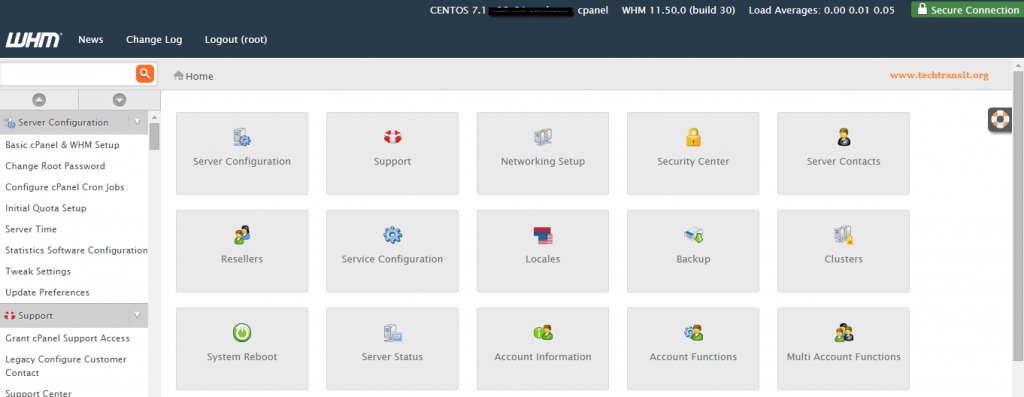
Now script will run some hours and after installation you will get some output  like , time taken in installation as well as server access url and access details, you will use in login root as a user and use password of root user.

You will get WHM access like below url.
ACCESS URL:

https://your –server-public-ip:2087/

OR

https://server-hostname:2087/
cpanel_11.50_centos7

cpanel_11.50_centos7

After access of url in browser and put the username password details in access url and accept license agreement, you can configure server networking, ip address and nameserver as according to you , you should have good nice knowledge of System Admin part.

Hope you enjoy this post , for any concern please comment here and give us feedback. Thanks
Continue Reading